
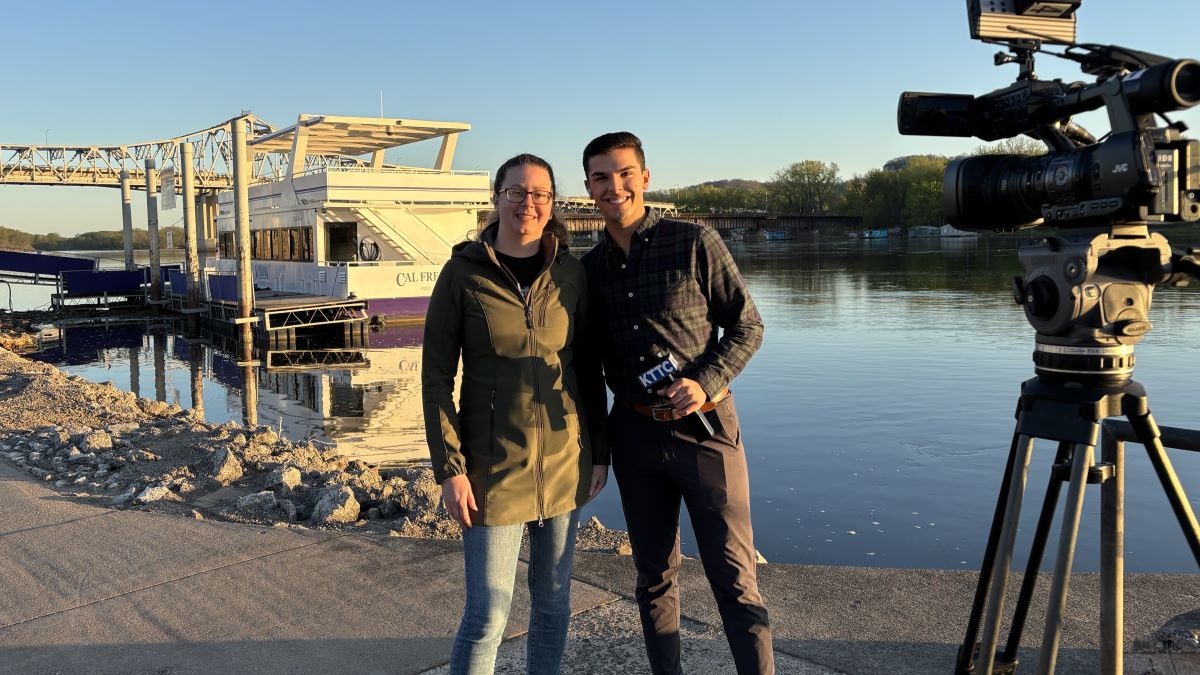
Sun gathers in pools atop the water. Its rays spark reflections from shore to shore. It’s what the river brings at 5:30am: a magnificent sunrise at Levee Park.
It’s also the perfect time for our Museum Educator, Jennifer Weaver, to film with the KTTC Morning Show about History on the River Cruises. The popular boat rides on the WSU Skipperliner Cal Fremling combine art, culture, science, and history themes, and they’re beginning soon! That’s exactly what Jennifer got up so early to tell everyone listening on television.
Jennifer’s invitation to cruise with history on the Mississippi River makes me consider what the river brings to Winona County. Sometimes it’s needed moisture or raging floods. Sometimes it’s nutrients or an encounter with nature. Sometimes it’s products. Or ideas. Or people. But if I’m honest, I’ll admit that not everything that flows up, down, or into the river has positive effects on the world.
Clamming Industry
The programs for this year’s History on the River Cruises mirror this fact. “The Clamming & Pearl Button Industry“ is a prime example. The story of button processing, as told by Terry Visger, reveals a problem. Fishers hunted freshwater mussels to near extinction. Now these animals, once prized as practical (and shiny!) clothing fasteners, are one of the most endangered creatures in the U.S. today.
Healthy Waterways
“Healthy Waterways“ also explores an element we can’t live without: clean water. The fact that I’m talking about healthy waterways is a clue that we understand the opposite reality. Some of our waterways are unhealthy, and John Howard and Sheila Harmes are ready to explain why. Whether we deal with pollution from current practices or from bad habits of long ago, we can make a difference in water health for the future. It starts with our own awareness. Taste the difference for yourself at Sheila and John’s “Water Bar” experience. As you taste-test, you won’t be able to miss the flavor of health.
Métis Fur Traders
If you end up sitting on the Cal Fremling this summer, you’re an example of how the river moves people. That’s what Mary Elise Antione will tell you more about if you attend her program. She’s talking specifically about the Métis (mey-TEE), a people group of mixed-ancestry, along the stretch of river from St. Paul, MN to Prairie du Chien, WI. Mary Elise shines a light on their role in the fur trade during the 1600s to 1800s. The Métis balanced both indigenous and white settler cultures, which often challenged them to create new communities and adapt to a world that changed constantly around them.
What can you do?
Let’s get back to honesty: we’ve created lots of problems for ourselves over the years. We’ve misused land and water. We’ve underestimated the people around us. What can we really do about these big concerns as individuals?
- Take the initiative to learn. Join an educational cruise, participate in a club, voice your concerns in a community conversation, or read a book that adds to your knowledge of problems and solutions.
- Acknowledge that bad things are part of our history. Realize that people commit terrible acts against nature and other humans. We are products of history, but we have the ability to respond.
- Treat every day as a crisi-tunity! Do your part in your little corner of the world to heal nature or make others feel appreciated and seen.
If you’re interested in booking one of the cruises above, call 507-454-2723 ext. 0 or stop in at the Winona County History Center.

This is a really well-written post! The content is clear, engaging, and shows real expertise. I appreciate the effort that went into creating such valuable information. I look forward to reading more from you in the future. Keep up the great work!