Welcome back! We’re picking up where we flew off last week with Part II of pigeon racing in Winona!
A Wing and a Prayer
As mentioned in our last post, pigeon races can get hairy (or feathery?) in a lot of different ways. Weather is a common danger for racing birds. Storms can injure a bird, or blow it so far off-course it can’t find its way back. Natural predators such as hawks, and man-made obstacles such as traps, buildings, or vehicles also pose potential threats.
Fowl Play on the Flyway
And there’s always the danger of a bird getting shot by a hunter or homeowner. People who discover banded racing pigeons in their yards have long been encouraged to feed them, give roosting space, and release them. Historically there have been fines levied on people who deliberately killed or caught racing pigeons. It’s little wonder—once cash racing prizes became more common, pigeons could potentially bring home a lot more than their weight in figurative bacon. For an extreme example, in 2020 a Belgian racing pigeon set a Guinness World Record at auction, selling for $1.8 million dollars.
Rest, Roost, Repeat
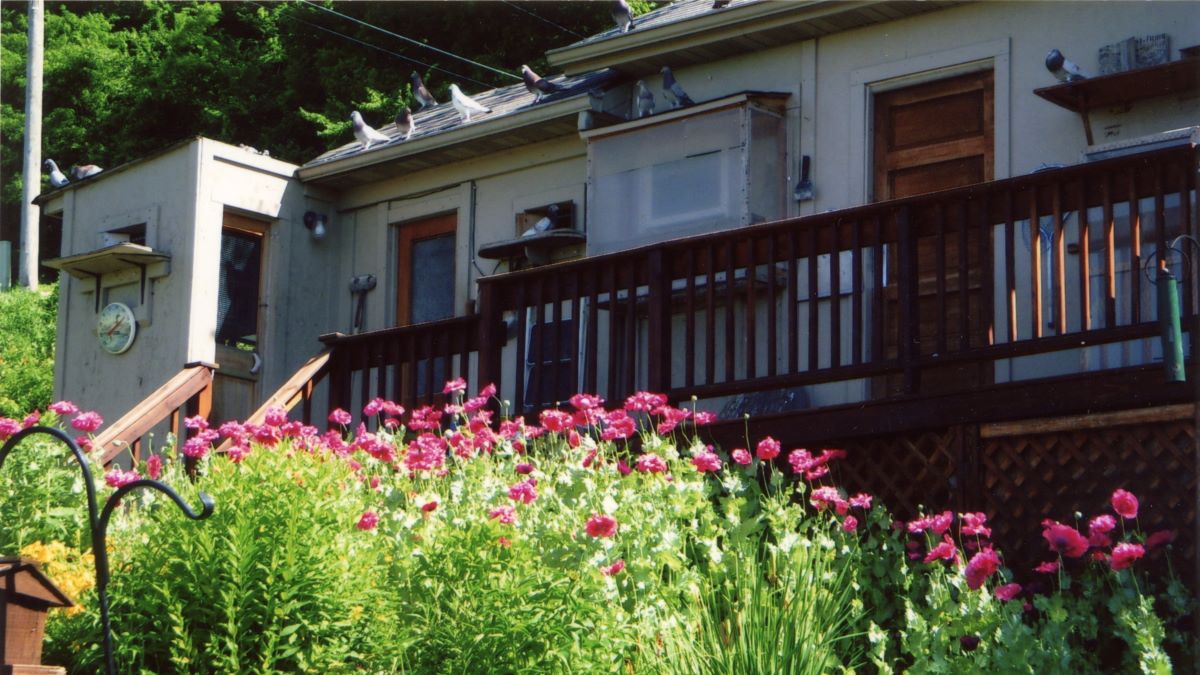
If and when the birds do finally return, their familiar hutch and feed will be waiting for them to rest up, eat, drink, perhaps do a little billing and cooing with a mate, and then start the process all over for another race.
Birds About Town
To swing back local again, pigeons are a familiar Winona sight, having long been drawn to both the natural river environment and the abundance of grain from milling companies, barge traffic, and railcars. For a different sort of hobbyist, city pigeon shoots were a common method for dealing with excessive droppings on Winona streets. But breeders and racers have been here, anecdotally at least, since the 1920s and 30s.
Newsprint evidence of the local clubs is a bit harder to nail down. Some standout locals who bred pigeons for show or racing included Al Lejk, James Bronk, Frank Bork, Harvey Berg, Joseph Kammerer, Allen Goetzman, and Dick Lano. Dick did a talk on pigeons for a 1985 meeting of the Hiawatha Valley Audubon Society (now the Winona Bird Club). The Southeastern Minnesota Pigeon Fanciers, a group made up of both racers and breeders, is noted as “racing pigeons all summer” in a 1941 Winona Republican Herald article, releasing birds “north of Minneapolis.” The Racing Homers, Great River Racers (active from the 1980s through the early 2010s), and the La Crosse International Flyers (active in the 1960s-1980s) all make brief news
appearances.
Where the Flock Gathers
Pigeon racers are certainly still around today, though Winona clubs and members may tend to ebb and flow. Current groups listed on the AU’s website include: La Crosse United Flyers, Rochester RPC, Westconsin RPC, and the North Star Flyers Club. Also notable is the Midwest Homing Pigeon Association, founded by Wisconsin and Minnesota organizers as the Midwest Racing Pigeon Organization in 1948, which runs multiple annual races. The hobby-sport is growing in other ways as well; what was once a predominantly white and male pastime is increasing its women members, as well as gaining traction and enthusiasm in the Hmong and Mexican-American communities.
While you may not have been convinced to join up or go dangling from an interstate bridge girder in pursuit of your own squab, do take a closer look the next time a pigeon follows you down the sidewalk. If it’s banded, it could be taking a French fry break on its way home from a long race.
Acknowledgements
Many thanks to Robert Keiper for resources, images, and his interview about all things racing pigeons!