
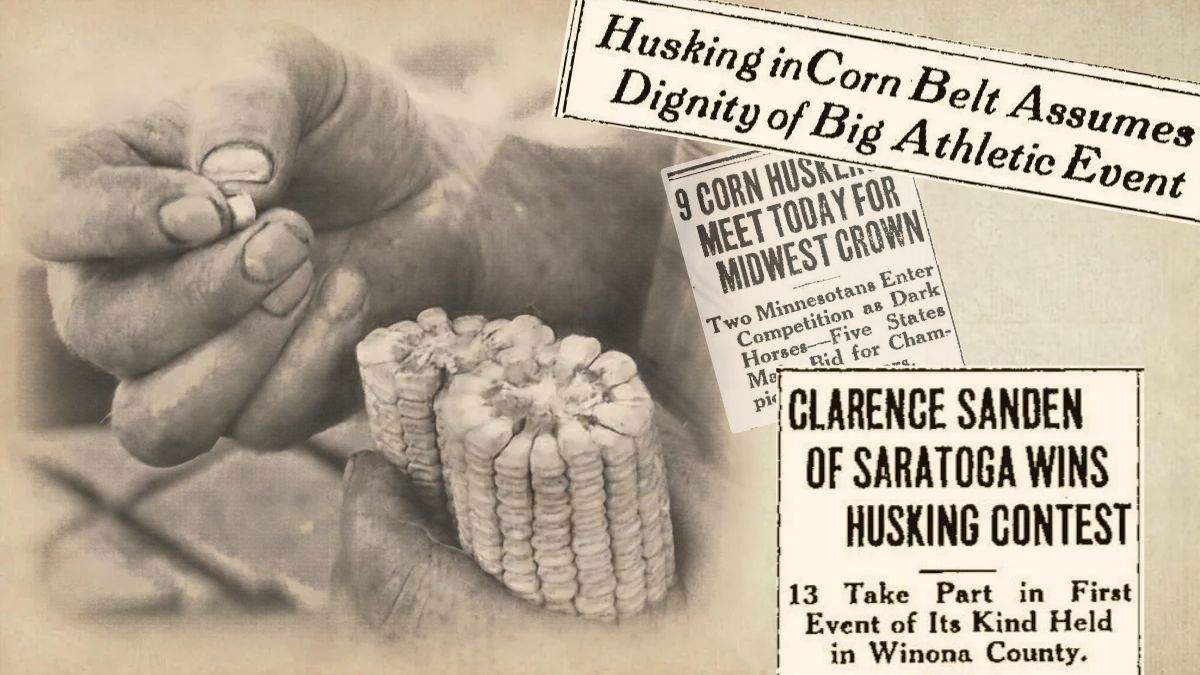
It’s a tradition for the kids in my family to gather in the late August heat for a goodhearted corn-husking contest. As adults tend to the scalding and cutting of sweet corn, the youngsters scrabble atop a pickup truck full of unshucked ears. They husk their hearts out, sneaking sideways glances to keep an eye on the competition.
Little do they know they are following in the footsteps of midwestern athletes. In 1922 – the same year Babe Ruth was signing on with the New York Yankees baseball team – another sport was growing across the region. Corn-husking.
A Chore to Score
Harvesting corn in the days before machinery was, in the words of the Winona Republican-Herald newspaper, “one of the most irksome of jobs.” Corn plants could be sharp – think papercut on steroids. Though fall weather might be alternately frigid or uncomfortably warm, perspiration was a certainty. The constant motion of picking, the thump of the ears against the wagon “bangboard,” and the endless swaying cornstalks was a recipe for madness.
In true midwestern fashion, folks from the corn belt discovered how to turn this monotonous job into a competition. The Iowans started a craze in 1922 when magazine editor Henry Wallace sponsored a state-wide competition. Before you could say “Aw, shucks,” Nebraska, Indiana, and Illinois struck up their own competitions. A regional midwest contest grew out of these statewide events. In 1925, T.R. Iverson and S.M. Selvog were the first two Minnesotans to challenge for the corn-husking title alongside other cornbelt states.
Winona County Is All Ears
The press was calling the huskers “artists” and “athletes,” and Winona County wanted a chance at the “gold and glory” too. The first-ever county competition took place in 1933 at the J.H. Nahrgang farm southeast of Lewiston, Minnesota. Participants from Wiscoy, Utica, Fremont, St. Charles, Saratoga, Norton, and Elba flung ears to the sky. A young Norwegian man, Clarence Sanden of Saratoga, emerged from the cornfield with a load weighing 1,670 pounds. He beat the nearest challenger by over 80 pounds. Clarence moved on to the state competition less than a month later, and placed 20th overall.
The Battle of the Bangboards
Just how did this “battle of the bangboards” work? A number of committees – field marshalls, starters, weighmasters, referees, wagoneers, gleaners, and other officials – monitored and measured the contestants’ progress. The huskers worked for 80 minutes straight, rain or shine. Each brought a competitive edge – from the one-handed picking method to exercise regimens to prayer.
These special skills helped participants overcome competition challenges. Since corn grew differently across geographic regions, stalk conditions could favor certain pickers. Missed stalks, dropped ears, or corn that was poorly husked all deducted from final scores. Whoever came out on top in the county competitions entered the state contest. The winners at state earned the right to compete nationally.
Rooted in Community
By 1934, the national following for competitive corn-husking had grown so much that the national guard was called in for crowd control. The sport had taken on a deeper meaning. People living through the Great Depression era needed a reason to keep their chins up. They found pride in hard work – work that helped them unite and survive.
Though it still has a national presence, corn-husking hasn’t made a comeback in Winona County yet. Nowadays, the only type of corn most of us hold in our hands is the popped kind in a bowl.
But traditions have a way of surprising us. All it takes is a few people willing to get their hands dirty and remind us what our ancestors already knew: there’s pride in hard work, strength in community, and value in slowing down long enough to appreciate both.
Until then, we’ll just have to wait and see. After all, stranger things have happened when corn flies.

Leave A Comment